
Asbestos pipe insulation and lagging were very commonly used from the 1930s until the mid-1980s, and sometimes even until the turn of the millennium. Asbestos is an excelling heat insulator so it was perfect for the thermal insulation of pipes. Unfortunately, the health risks associated with asbestos materials started to be uncovered and its use was finally banned in 1999.
If your pipes use asbestos lagging or insulation, then it can often be safer to have it removed. The cost can vary depending on the technique used to apply the insulation, the location of the pipes, the length of the pipework, and the condition of the asbestos. Asbestos lagging is one of the most dangerous asbestos materials which also adds to the removal costs.
At Asbestos SOS, we can help with your asbestos lagging and pipe insulation removal. Our team of professional asbestos removal specialists will assess your asbestos pipe insulation to determine the best course of action for removal. We will then provide you with a clear and detailed quote for the likely asbestos removal costs. Then our team will remove the asbestos safely and efficiently and dispose of it in line with regulations.
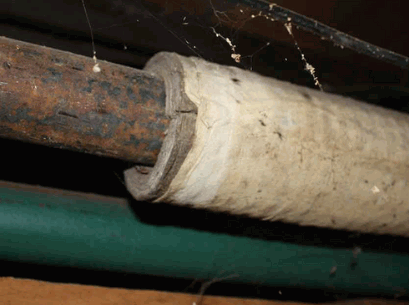
Asbestos is a naturally occurring mineral consisting of tiny fibres. Its unique composition provides it with attributes that gave it the name "the magic mineral". It is fire, electrical, heat, and water resistant. It also provides excellent sound and thermal insulation. And it is cheap, versatile, and easy to mine.
It is no wonder, then, that asbestos became the material of choice throughout the construction industry during the boom in house building in the mid-20th century.
Asbestos-containing materials were used throughout homes, commercial property, medical buildings, schools, and more. It spiked in popularity from the 1930s up until the early 1980s. By this point, it was becoming clear that asbestos exposure was the likely cause of health problems in many people and it started to become heavily regulated. By 1999, it was fully banned as a construction material in the UK.
Uncover more: What Does Asbestos Look Like

Asbestos is a dangerous cancer-causing material. It was suspected for some time that asbestos exposure may have been linked to certain serious and fatal diseases. Since the symptoms can take decades to appear after exposure, however, it took a long time for this link to be confirmed.
It is the microscopic fibres in asbestos that are dangerous to human health. When we breathe in or ingest these fibres, they remain in our bodies. After some decades, they can trigger a range of health conditions, some of which can be fatal.
These include:
Any exposure to asbestos fibres can cause these diseases later on in life so it is important to keep yourself safe. There are still around 5,000 deaths per year in the UK attributed to asbestos exposure.
Pipes need good insulation. They are made of metal which conducts heat very well. This can be a problem when you are using pipes to transport hot water as it will cool down very quickly.
Asbestos insulation soon became a favourite for use in pipe insulation. It is a highly effective heat insulator and it is easily manipulated to fit around the different turns and twists that you find in pipework. It can be added in layers and it is a cheap and easily sourced material.
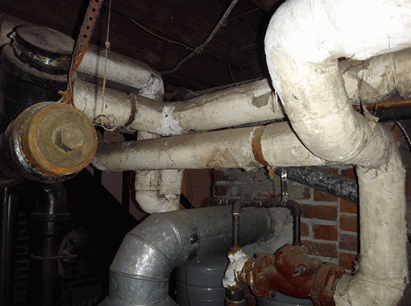
The general rule of thumb is that asbestos is relatively safe as long as it is not disturbed. While it is in place and not being touched, the asbestos fibres are sealed into the asbestos-containing materials.
Asbestos becomes dangerous when the materials are disturbed in some way, through damage, sawing, breaking, etc. When this happens, the fibres become airborne and can then be inhaled or ingested.
When it comes to pipe insulation, however, extra caution is advised. The asbestos-containing thermal insulation used for pipe lagging is one of the most dangerous asbestos materials.
It consists of up to 85% asbestos fibres. When you compare that to something like Asbestos Insulating Board (AIB), which is also considered a dangerous asbestos material, yet it is 16% - 35% asbestos fibre, you can see why extreme caution is advised around asbestos thermal insulation.
Partially because of its extremely high asbestos content and because of the type of material, asbestos pipe insulation is highly friable. Friable asbestos is asbestos that can be easily crumbled just through touch. When asbestos crumbles it creates asbestos dust. This contains asbestos fibres that become airborne.

Removing asbestos is a difficult task. It carries with it health risks that need to be carefully managed and it is a tough material that can be difficult to get out.
Asbestos pipe insulation can be even more challenging than other types of asbestos removal. When you think of removing something like an asbestos garage roof, this is a relatively simple task. The roof is easily seen and accessible and can be dismantled cleanly.
Pipe insulation, however, is quite the opposite. Pipework is generally hidden in voids and ducts within the construction of a property. You will find pipework in underfloor ducts, lofts, ceiling voids, and within walls. These are tight spaces that require specialist skills to access. When you consider the health risks associated with inhaling asbestos fibres, working in such confined spaces will need a lot of safety precautions.
The way that asbestos insulation is applied to the pipes can also make the removal more challenging. Coming back to the asbestos garage roof, this will have been applied using pre-constructed boards attached with nails and screws that can be dismantled fairly easily and in one piece.
Pipe insulation, on the other hand, is applied in two different ways:
In practice, both types of applications were often used. Sectional asbestos insulation would be applied to long straight sections of pipework. Hand-applied asbestos insulation would be used for harder-to-wrap areas, such as bends.

The removal costs for asbestos pipe insulation and lagging can be relatively high compared to other types of asbestos removal. This is because it creates a variety of additional challenges that require a higher level of skill and experience, safety equipment, and time.
Different removal methods will impact the cost.
This is the simplest way of asbestos removal for pipe insulation and lagging and it involves the removal of the entire pipework.
The pipework is wrapped tightly with many layers of polythene to prevent damage to the asbestos and to create an airtight seal. Where there are natural breaks in the asbestos insulation, the pipe will be cut using a reciprocating saw.
The pipe section is then lifted out and carefully bagged ready for disposal.
This method is best used when the pipes are older and will need replacing anyway. It is also a cheaper option than the injection method of removing asbestos insulation. Although it will end up being more expensive once you factor in the price of replacing the pipework, if they need to be replaced anyway, it is more cost-effective to do it all in one go.
The weight of the asbestos waste will be a lot higher using this method because of the additional weight of the pipes, so disposal fees will be higher.
You can expect to pay around £145 per linear metre (Lm) for a wrap and cut removal for easily accessible pipework.
For pipework in underfloor ducts, the average cost will be £165 per Lm.
For pipework in a loft or ceiling voids, the average cost will be £155 per Lm.
The length of the pipework and other aspects will also affect the overall cost.
This method preserves the pipework and leaves it in place. It is a more expensive and complicated technique than wrap and cut but it does mean that you won't have the additional costs of replacing the pipes.
Asbestos removal should only be done while the asbestos is wet. Breaking up and damaging asbestos when it is dry will make fibres fly into the air which can then be inhaled. When the asbestos is wet, the fibres remain mainly sealed, lowering the risk during removal.
Because asbestos is so water resistant, simply spraying it with water isn't usually enough to keep the material wet. The water won't absorb deep enough into the asbestos to prevent the fibres from being released.
The injection method uses specialised injection needles with valves. The asbestos is wrapped in cling film and the needles are inserted deep into the material. Then a special fluid that seals the fibres is very slowly injected into the asbestos.
Once the asbestos is fully saturated and wet, then it can be carefully removed using hand tools and bagged ready for disposal.
The average cost for removing asbestos pipe insulation using the injection method will be £195 per linear metre (Lm) for easily accessible pipework.
For pipework located in underfloor ducts, removal will cost an average of £221.
For pipework located in loft or ceiling voids, removal costs an average of £210.
Sometimes, you may find that you have the remnants and debris of old asbestos insulation in and amongst your pipes. It may be that the original asbestos insulation was inexpertly removed long in the past and some of it was missed. You may even find some underneath modern insulation.
The cost of removing asbestos debris will depend entirely on how much of it there is and where it is located. It will be much cheaper than full asbestos pipe insulation removal, however.
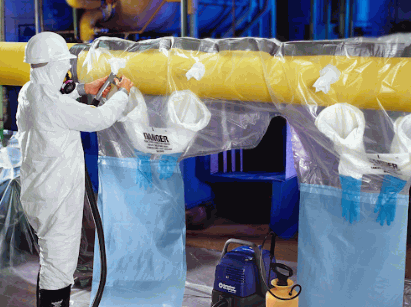
Because asbestos is generally quite safe when it isn't being disturbed, some people opt for asbestos encapsulation rather than removal. This involves sealing the asbestos with a special coating or boxing it in with plasterboard and other methods.
Asbestos pipe insulation, encapsulation is achieved by using a product such as rewettable pipe lagging. This is a fibreglass canvas that is wrapped around the pipes on top of the asbestos insulation and prevents the fibres from escaping.
While encapsulation does lower the risk of asbestos greatly, it is worth remembering that the asbestos will still be present and may still need to be removed at some point in the future.
The cost of asbestos encapsulation is around £25 per square metre.
Once the asbestos is removed, it will need to be disposed of properly. Asbestos waste can't be placed with normal household rubbish and will need to be transported safely to an approved landfill.
Asbestos fibres are invisible to the naked eye. This is why a full and detailed cleaning must be conducted after asbestos removal. An asbestos removal company will use specialist cleaning tools that are designed to remove the asbestos dust and fibres completely and safely.
Normal vacuuming and dusting, for example, will agitate the fibres making them fly into the air where they can be inhaled. But specialist asbestos cleaning equipment will minimise this.
If you are unsure about whether or not your pipe lagging or insulation contains asbestos, you can have an asbestos survey conducted.
This entails taking a sample of the suspected asbestos materials and testing them for the presence of asbestos.
An asbestos survey will cost between £50 and £200+ depending on how much material is being tested. You can opt to have a full survey conducted of the property to check if there are any other asbestos-containing materials present.
Trying to conduct asbestos removal yourself is never advisable, especially not for pipe insulation. It is one of the most friable asbestos materials and contains a very high percentage of asbestos fibres.
There is no safe exposure to asbestos. Any amount of asbestos that you inhale can cause serious and fatal diseases.
Specialist asbestos removal companies will use proper asbestos removal techniques and will have high-quality safety equipment and procedures in place./
These include:
Take a look: How To Tell The Difference Between Cellulose And Asbestos Insulation
We are a professional and highly trusted asbestos removal company with many years of training and experience under our belt. Our goal is always to make asbestos removal as efficient and safe as possible for everyone involved.
When you contact us for your asbestos removal, we will first conduct an assessment. If you are unsure about whether or not asbestos is present, we will carry out asbestos testing for you. If asbestos is present in your pipe insulation, we will develop a clear and detailed plan for the best method of removal.
You will have input on the chosen method and we will work with you from the very beginning to ensure that you are comfortable with the plan. Our professional team will advise you on the best way forward depending on the location of the asbestos, its condition, the location of the pipework, and other factors. We will also provide you with a clear and detailed quote for the asbestos removal cost so that you know exactly where you are from day one.
The asbestos removal itself will be carried out with proper risk assessments and safety precautions in place to ensure that our team and you are kept safe. We will take charge of the disposal of the asbestos waste and will ensure that the area receives a detailed cleaning and is free from asbestos dust and fibres once the removal is complete.
Asbestos pipe insulation was commonly used in building construction for much of the 20th century. It was an excellent insulating material that was cheap and easy to source., The substance was banned in 1999, however, because of the severe health risks associated with it, such as lung cancer. If you have asbestos pipe insulation in your home, it is advisable to have it removed if possible. While asbestos fibres pose a little risk unless they are disturbed, any type of accidental damage can cause them to be released. The presence of asbestos may also devalue your property.
The removal of asbestos pipe insulation can be challenging because of the high risk associated with that type of asbestos material and because of the difficulty in accessing pipes located in confined spaces. Because of this, the asbestos removal cost is often higher than for other types of asbestos-containing materials.

