
Asbestos was commonly used for insulation in and around boilers and flues from the 1970s up until the early 1980s. The substance was banned in the UK in 1999 because of the danger it poses to human health. If you have a boiler that was installed pre-1999, there is a chance it could have asbestos surrounding it. The cost of removing asbestos from a boiler and flue will be, on average, approximately £350. But there are often additional costs involved. Read on for a complete breakdown of what to expect.
At Asbestos SOS, we are experienced in all aspects of asbestos removal. We can work with you from the testing stage through to the removal stage, and finally the clean-up. You can be sure of a thorough, safe, and cost-effective job conducted by trained professionals.

Asbestos is a mineral. It is cut from quarries for a variety of uses and is made up of tiny fibres. It has been used in some form as a building material since the 19th century because of its unique attributes. These include fire, heat, electrical, and water resistance as well as sound/heat insulation.
Check out: What Does Asbestos Look Like

The inhalation and ingestion of asbestos fibres are easily done when working with the material. These tiny microscopic fibres cannot be expelled from our bodies and remain there. After some decades, the presence of the fibres can trigger serious, and often fatal, diseases. These include:
Deaths from asbestos-related diseases are still a major problem, with approximately 5,000 people dying from them per year. These are mainly construction workers who regularly come into contact with asbestos materials.
Asbestos exposure is most likely when the material is disturbed in some way. For example, during renovations. As soon as asbestos-containing materials are cut or damaged, asbestos fibres will be released into the air. The fibres often can't be seen and once they are airborne, they can be inhaled or ingested without realising.
There are six different types of asbestos:
The three most common types of asbestos used in construction materials were white, brown, and blue asbestos. If your boiler and flue contain asbestos, it is almost certain to be one of these. However, the asbestos could be contaminated with fibres of another type as well.
It is a myth that some types of asbestos are safe. All types of asbestos are classified as cancer-causing substances by leading health agencies.
Boiler systems are complex and they rely on careful insulation of heat in several key areas. Asbestos, in various forms, was often used as boiler insulation because of how well it insulates and because of the material's versatility. It was also used as a sealant and lining.
You could see asbestos in boilers used as:
There is no way of telling whether your boiler contains asbestos through sight alone. Asbestos-containing materials can look identical to asbestos-free materials.
The only way to be sure if there is asbestos in your boiler is to have an asbestos survey conducted. With an asbestos survey, a professional will test the materials in your boiler for the presence of asbestos fibres. Knowing where to look and how to obtain proper sampling from a complex system like a boiler is difficult without training, so it is always best to leave this to a professional asbestos company.

Not everyone will choose to have asbestos removed if it is found. The asbestos removal cost can sometimes be quite high and removing asbestos is a difficult, messy, and time-consuming task.
While asbestos is a dangerous substance, the danger only occurs when the asbestos material is disturbed in some way. If there is no disturbance, then the asbestos fibres will remain bonded in the material and won't become airborne.
The problem with boiler systems, compared to something like Artex ceilings, is that there is a greater chance of the asbestos materials getting disturbed. There are lots of different active elements in a boiler, a higher potential of damage to the asbestos materials, and more of a need for work to be conducted on it.
Because of these issues, many people opt for full asbestos removal for their boiler system.

Using a professional asbestos removal company to remove your asbestos boiler is important due to the risks involved. It can also be a messy and time-consuming task. Asbestos is a hard material that adheres to surfaces very strongly so it can take a lot of skill to remove it properly.
Your first step will be to discover if your boiler does contain asbestos. This is done by completing an asbestos survey which tests samples of the material surrounding the boiler. If you find asbestos in these samples, then you can decide on the next steps for removal.
There are home testing kits that you can buy to do the testing yourself, but they aren't always accurate, especially with asbestos boilers. Several different components could contain asbestos in a variety of forms, so using a trusted professional will ensure that the testing is thorough.
In some older homes, there is a chance that the boiler asbestos is just the tip of the iceberg. There may be asbestos materials throughout the home. In this case, you could opt for a full house survey.
Some people choose to assume that their older boiler and associated flue contain asbestos. Most boilers pre-1985 would have contained asbestos, so on the balance of probabilities, it is often safe to assume that there will be asbestos present.
If your boiler was installed between 1985 and 1999, it is less likely but still possible that it will contain asbestos. In this case, an asbestos survey to find out for sure can be a good idea.
An asbestos survey will usually cost between £50 and £200, depending on how wide a scope you want the survey to have.
Some homeowners opt for asbestos encapsulation rather than full asbestos removal. Asbestos encapsulation is all about controlling and managing the risk present in asbestos. When asbestos is contained, the risk is very low. The danger of asbestos occurs when the fibres are disturbed and become airborne.
The asbestos is sealed so that the fibres remain in place. There are a variety of products that can be used to encapsulate asbestos. One option is to use a fibreglass canvas, wrapped around the asbestos-containing material, which is then cured so that it hardens.
Before asbestos encapsulation can be completed the asbestos will need to be examined. If it has deteriorated to the point of crumbling, then encapsulation may not be a viable or safe option. In this case, you would need to opt for asbestos removal.
Asbestos encapsulation costs between £10 and £25 per square metre. The exact price will depend on the size of the boiler, and which elements will need encapsulation.
The asbestos boiler removal process can be complex, depending on the type of boiler, its location, and the condition of the asbestos.
An asbestos removal company will take careful precautions when dealing with asbestos. Once the asbestos starts to be disturbed through removal, then the danger of asbestos fibres spikes.
These precautions will include:
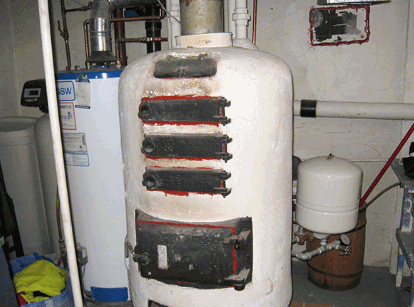
The asbestos removal cost will depend on a variety of factors, including the size of the boiler, the condition of the asbestos, and where exactly the asbestos is located.
On average, you could expect to pay:
Additional asbestos surrounding the flue will increase the cost of removal. This cost will depend on the length of the flue, the condition of the asbestos, and the ease of access.
You could expect to pay between £100 and £250 for asbestos flue removal.

Alongside the asbestos removal cost, there will be additional costs that you will run into afterward.

You will need to get a new boiler to replace your old one. The cost of a new boiler can vary greatly but, with labour costs included, you can expect to pay between £2,000 and £4,500 for a new boiler.

You may need to refinish and redecorate the area where the boiler and flue were. This could cost around £400-£600.
It is not a good idea to attempt to remove asbestos yourself. As soon as you start cutting into or dismantling the asbestos material, asbestos fibres will start to be released. These airborne fibres are often invisible to the naked eye but you will be inhaling and ingesting them. There is no safe level of asbestos exposure. Any amount of asbestos fibres can cause asbestos-related diseases later down the line.
While asbestos removal costs can be quite high, it is always better to use a professional company for this job. They will understand the health risks and will take proper precautions to keep themselves safe.
Asbestos disposal is also a concern. You can't put asbestos in a household waste bin. It will need to be disposed of in specific landfills that can accommodate the material and it should be transported there safely.
A professional asbestos removal company will have a hazardous waste carriers licence and will work with the local council to dispose of the material in compliance with asbestos regulations.
If you suspect that your boiler and flue could contain asbestos, we can help. From the initial testing stage, through the removal stage, and to the disposal stage, we will work with you every step of the way.
Our team will conduct thorough professional asbestos testing to find out if there is asbestos presence. If it is, we will go through the next steps with you and create a schedule for removal that works for you. We will also give you a clear and thorough quote for the expected asbestos removal cost so you will know from day one what the process will look like for you.
Our team is highly trained in working with asbestos as a hazardous material and will take all of the necessary safety precautions to protect themselves and you. They will also dispose of the asbestos waste safely and in line with asbestos regulations.
Boilers and flues commonly contained asbestos from the 1960s up until the early 1980s. It is a highly effective insulator but asbestos fibres are extremely hazardous to human health. If you suspect that your boiler or flue could contain asbestos material, you can get them removed by a professional removal company. The full asbestos removal cost will depend on a variety of factors, including the size of the boiler or flue, the condition of the asbestos, and the complexity of the removal.

